2 Bottles
60 servings · 2 x 60 capsules

$69 / bottle
$138 total$198
- 2 bottles · 120 capsules
- 60 servings of 2 capsules
- 60-day money-back guarantee
- Shipping charged at checkout
USA authorized retailer. Call +1 (282) 450-4273.
Product information
"Glucotide is a dietary supplement capsule for everyday blood sugar support."
Use case: adults take 2 capsules a day with food and an 8 oz glass of water. A bottle holds 60 capsules and lasts 30 days.
How it works: seven nutrients, including biotin, chromium, zinc and magnesium, come with printed amounts, next to an 82 mg blend of 12 more ingredients led by licorice root extract.
Sources read on September 24, 2026 · order desk +1 (282) 450-4273 · this site publishes no rating


Marks from the seller’s artwork. No certifying body, certificate number or audit date was supplied for any of them.
Percent of the Daily Value, as printed7 nutrientsScale runs to 250%; the line marks 100%
Vitamin Cas Ascorbic Acid
59%
Vitamin Eas d-alpha tocopheryl acetate
107%
Biotin
1050%
Magnesiumas Magnesium Oxide
30%
Zincas Zinc Oxide
73%
Manganeseas manganese sulfate
43%
Chromiumas Chromium Amino Acid Chelate
217%
Every figure above is printed on the label, not worked out here. We checked the six our sources give a Daily Value for and every one we could check is arithmetically right. Six of the seven: NIH gives no Daily Value for manganese in the sheets we opened, so the 43% is the one line here we have not checked. Three run past the 100% mark: vitamin E at 107%, biotin at 1050% and chromium at 217%. Biotin is past the end of the chart, so its bar is drawn running off the scale. The 82 mg proprietary blend of 12 more ingredients is not on this chart, because it has no percentages to draw.
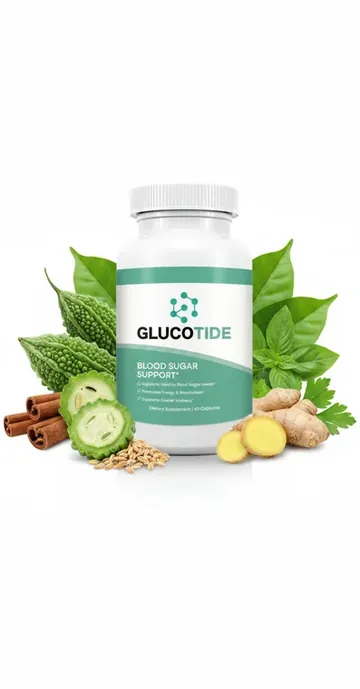
The Glucotide bottle prints four support lines: Blood Sugar Support, Supports Healthy Blood Sugar Levels, Promotes Energy & Metabolism and Supports Overall Wellness. It also prints a serving of 2 capsules and 30 servings in 60 capsules.
Glucotide prints seven nutrients with amounts and an 82 mg blend of 12 more. Biotin is 315 mcg, or 1050% of the Daily Value, far below the doses in lab-test reports. The bottle also carries a licorice warning about blood pressure.
Glucotide's panel prints seven nutrients with amounts and Daily Values, plus an 82 mg proprietary blend of 12 more ingredients with no individual weights. The serving size is 2 capsules, with 30 servings per container.
The panel gives Serving Size 2 capsules and Servings Per Container 30. Under the Amount Per Serving rule it prints seven nutrients, each with a weight and a percentage of the Daily Value, and then a Proprietary Blend, 82 mg, marked with a dagger and the footnote that a Daily Value is not established, with 12 ingredients indented beneath it.
| Nutrient | Per serving | %DV as printed | The DV it is measured against |
|---|---|---|---|
| Vitamin C | 53 mg | 59% | 90 mg (NIH) |
| Vitamin E | 16 mg | 107% | 15 mg (NIH) |
| Biotin | 315 mcg | 1050% | 30 mcg (NIH) |
| Magnesium | 125 mg | 30% | 420 mg (NIH) |
| Zinc | 8 mg | 73% | 11 mg (NIH) |
| Manganese | 1 mg | 43% | not given in the sheets we opened |
| Chromium | 76 mcg | 217% | 35 mcg (NIH) |
Six of those Daily Values are quoted directly from the NIH fact sheets listed at the foot of this page. Divide each printed amount by its Daily Value and you get the printed percentage, every time: 53 over 90 is 58.9%, rounded to 59; 16 over 15 is 106.7%, rounded to 107; 315 over 30 is exactly 1050. Every percentage we could check is right. The seventh is manganese: NIH’s fact sheet for health professionals would not load on the day these sources were read, and its consumer sheet gives an upper limit of 11 mg but no Daily Value. So the 43% on that line is the one figure on this panel this site has not checked, and we would rather write that than divide by a number we did not open.
Select a number on the bottle, or use the arrow keys.
GLUCOTIDE, with a linked-node mark above it. GLUCO in black, TIDE in teal.
The asterisk ties this line to the FDA disclaimer on the back. It is a structure and function claim, not a finding.
Healthy blood sugar levels, energy and metabolism, overall wellness. All three are asterisked and all three are on the bottle.
30 servings of 2 capsules. Two into sixty is thirty, so a bottle is exactly 30 days at the printed serving.
WARNING: Licorice root may elevate blood pressure at high doses. Not for use by persons with hypertension, heart disease, liver or kidney disorders, or for prolonged periods without medical supervision.
That sentence is printed on the bottle. It is not in the supplier pack, not on the ingredient panel, not on the supports panel and not on the how-it-works panel. Exhibit 03 is about it.
Glucotide has 315 mcg of biotin per serving, which is 1050% of the 30 mcg Daily Value. Biotin can interfere with some lab tests, but the reported cases involve doses of 10 to 300 mg a day, far above this label.
| What | In micrograms | Where it comes from |
|---|---|---|
| The Daily Value | 30 mcg | NIH: 30 mcg for adults and children 4+ |
| This label, per serving | 315 mcg | printed on the panel as 1050% of it |
| One dose that moved a thyroid test | 10,000 mcg | NIH: a single 10 mg dose, inside 24 hours |
| The case reports | 10,000 to 300,000 mcg | NIH: patients taking 10 to 300 mg a day |
Start with what is true. NIH gives the Daily Value for biotin as “The DV for biotin is 30 mcg for adults and children age 4 years and older.” The panel prints 315 mcg. That is 1050%, and the arithmetic checks. Biotin is also singled out by federal agencies for a reason that has nothing to do with nutrition. FDA puts it as: “Biotin, often found in dietary supplements, can significantly interfere with certain lab tests and cause incorrect test results which may go undetected.” NIH records that “Supplementing with biotin beyond recommended intakes can cause clinically significant falsely high or falsely low laboratory test results”, and that “A patient with a high intake of supplemental biotin died following a troponin test (to help diagnose a heart attack) that gave a falsely low result because the test was subject to biotin interference.”
The amounts in those reports are far larger than this bottle. NIH records that “A few recent case reports have described findings falsely indicating Graves' disease and severe hyperthyroidism in patients taking 10-300 mg biotin per day.” and that “Even a single 10 mg dose of biotin has interfered with thyroid function tests administered within 24 hours.” Ten milligrams is ten thousand micrograms. The 315 mcg on this label is about a thirty-second of that, and roughly a nine-hundredth of the top of the case-report range.
So this label is not a dose those reports describe. Anyone telling you a supplement at 315 mcg will break your blood test has skipped the numbers. We are not going to do that.
What remains true, and is worth acting on, is smaller and duller and free. NIH records that “FDA advises health care providers to ask their patients about any supplements they may be taking that contain biotin and to consider biotin interference as a possible source of error if laboratory test results do not match the clinical presentation of the patient.” This is a blood sugar product. The people who buy it are, by definition, people who have blood drawn — and the tests NIH names as affected include thyroid panels, vitamin D, and the troponin test used when someone arrives with chest pain.
The practical version fits in one sentence: tell whoever takes your blood that you take this, and how much biotin is in it. The number is printed on the bottle. Saying it out loud costs nothing and removes the one scenario where any of this would have mattered.
One more thing in the label’s favour: NIH is clear that “The FNB was unable to establish ULs for biotin because there is no evidence in humans that biotin is toxic at high intakes.” There is no upper limit for biotin because there is no evidence it is toxic at high intakes. The interference issue is about measurement, not about harm from the vitamin itself.
The Glucotide bottle prints a warning: licorice root may elevate blood pressure at high doses. It is not for people with hypertension, heart disease, liver or kidney disorders, or for prolonged use without medical supervision. The marketing does not mention it.
Printed on the bottle
WARNING: Licorice root may elevate blood pressure at high doses. Not for use by persons with hypertension, heart disease, liver or kidney disorders, or for prolonged periods without medical supervision.
Four groups of people are named on that line: anyone with hypertension, anyone with heart disease, anyone with a liver disorder, anyone with a kidney disorder. It also says not for prolonged periods without medical supervision, on a product sold in packs of two, three and six bottles — 60, 90 and 180 days of supply.
The ingredient it is about is licorice, which is first in the 82 mg proprietary blend. NCCIH’s licorice root page carries the same concern in more detail: “Licorice contains a component called glycyrrhizin, or glycyrrhizic acid, that can cause serious adverse effects, such as irregular heartbeat and cardiac arrest, especially when consumed in large amounts or in the long term.” And, importantly, not only at large doses: “Even small amounts of glycyrrhizin from licorice root products have been linked to severe adverse effects in people who consume a lot of salt, in people with hypertension, and in people with heart or kidney conditions.” NCCIH also records that “Interactions between licorice and corticosteroids have been reported.”
That licorice is in the blend, that it is first in the declared order, and that the manufacturer thought it worth printing a warning about.
How much licorice a serving contains, and how much glycyrrhizin that licorice carries. Neither figure is published, so the size of the concern cannot be judged from the bottle.
Licorice is first in the blend, so under the ordering rule it cannot exceed the whole 82 mg. That is a ceiling and nothing more.
Anyone on the four groups the label names, and anyone taking corticosteroids. The person to ask is your prescriber, not this site.
None of the marketing supplied with this stock mentions licorice at all. The seller’s ingredient panel shows six nutrients and no blend. That is the gap this exhibit exists to close: a reader who buys from the advert would not know the warning was coming.
Besides biotin, Glucotide lists vitamin C 53 mg, vitamin E 16 mg, magnesium 125 mg, zinc 8 mg, manganese 1 mg and chromium 76 mcg. Magnesium and zinc are oxide forms, which NIH says are absorbed less completely.
NIH is explicit about the form. “Forms of magnesium that dissolve well in liquid are more completely absorbed in the gut than less soluble forms.” And specifically: “magnesium in the aspartate, citrate, lactate, and chloride forms is absorbed more completely and is more bioavailable than magnesium oxide and magnesium sulfate”
Magnesium oxide is what this label prints. The 125 mg is not untrue — it is the weight of elemental magnesium in the capsule — but the share of it that reaches you is lower than the same figure in a citrate or a chloride, and nothing on the label says so. NIH’s supplemental upper limit is 350 mg a day, so 125 mg is comfortably under it.
Same pattern, and NIH puts a number on it: “Absorption of zinc from supplements that contain zinc citrate or zinc gluconate is similar, at approximately 61% in young adults; the absorption from supplements that contain zinc oxide is 50%.”
So roughly four of these eight milligrams are expected to be absorbed, against about five from the same figure in a gluconate. On blood sugar specifically NIH reports that “The supplements reduced fasting glucose, 2-hour postprandial glucose, fasting insulin, insulin resistance, glycated hemoglobin, and C-reactive protein levels.” and then says “Overall, the evidence to date is insufficient to support any conclusions about the impact of zinc supplementation on the prevalence or severity of type 2 diabetes.” Both halves belong on the page.
The mildest over-100% figure on the label, and the form named is the naturally sourced one rather than the synthetic: “Naturally sourced vitamin E is called RRR-alpha-tocopherol (commonly labeled as d-alpha-tocopherol); the synthetically produced form is all rac-alpha-tocopherol (commonly labeled as dl-alpha-tocopherol).” This label prints d-, the natural form.
The caution is about who is taking it rather than how much. NIH: “Taking large doses with anticoagulant or antiplatelet medications, such as warfarin (Coumadin), can increase the risk of bleeding, especially in conjunction with low vitamin K intake.” 16 mg is not a large dose — the upper limit is 1,000 mg — but if you are on a blood thinner this is a line to raise with your prescriber.
The ingredient with the clearest link to this product’s category. NIH gives the Daily Value as 35 mcg, so 217% checks. Its trials used “doses of chromium picolinate were 200 to 1,000 mcg/day” — a different chromium salt and a larger amount than this. NIH also records that “The FNB concluded that no adverse effects have been linked to high intakes of chromium from food or supplements, so it did not establish a UL for chromium.” Two hundred and seventeen per cent sounds dramatic and, for this nutrient, is not.
Nothing to report on the vitamin C, and saying so is part of the job: not every line on a label has to be a finding.
The manganese is different, and the issue is not the nutrient. The seller’s own ingredient panel is titled INSIDE GLUCOTIDE — SIX VITAL NUTRIENTS and shows six. The panel prints seven. Manganese is the one left out, which makes that headline wrong against its own label rather than merely incomplete.
Nothing in our sources says magnesium oxide or zinc oxide is unsafe, and nothing here should be read that way. Both are ordinary, legal, widely sold forms. What NIH does say is that they are absorbed less completely than several other salts of the same minerals, which means a label printing a percentage of the Daily Value against them is quoting the weight in the capsule rather than the weight that arrives. Our sources say nothing about what any of these forms costs, so neither does this page.
The Glucotide blend is 82 mg in total for 12 ingredients, led by licorice root extract, juniper, guggul, alpha lipoic acid and bitter melon. No individual weights are published, but the declared order gives each one a ceiling.
Dietary ingredients contained in the proprietary blend that are listed under paragraph (b)(3) of this section (i.e., 'other dietary ingredients') shall be declared in descending order of predominance by weight, in a column or linear fashion, and indented under the term 'Proprietary Blend' or other appropriately descriptive term or fanciful name.
The phrase that matters is descending order of predominance by weight. Heaviest first, as a matter of regulation rather than of style.
The quantitative amount by weight specified for the proprietary blend shall be the total weight of all other dietary ingredients contained in the proprietary blend and shall be placed on the same line to the right of the term 'Proprietary Blend'
So 82 mg is the weight of all 12 together.
If the 12 are in descending order and weigh 82 mg in total, the ingredient in position n cannot weigh more than 82/n milligrams, because the n minus 1 above it are each at least as heavy. It is an upper bound and it is exact. It says nothing about how much smaller the real amount is.
| Rank | Ingredient | At most |
|---|---|---|
| 01 | Licorice (Glycyrrhiza glabra) Root Extract 4:1 | 82 mg or less |
| 02 | Juniper (Juniperus communis) Berry Powder | 41 mg or less |
| 03 | Guggul (Commiphora wightii) Gum Resin Extract (10% guggulsterones) | 27.4 mg or less |
| 04 | Alpha Lipoic Acid | 20.5 mg or less |
| 05 | Bitter Melon (Momordica charantia) Fruit Extract 4:1 | 16.4 mg or less |
| 06 | Cayenne Pepper (Capsicum annuum) Fruit Powder | 13.7 mg or less |
| 07 | Cinnamon (Cinnamomum verum) Bark Powder | 11.8 mg or less |
| 08 | Banaba (Lagerstroemia speciosa) Leaf Extract (1% corosolic acid) | 10.3 mg or less |
| 09 | White Mulberry (Morus alba) Leaf Powder | 9.2 mg or less |
| 10 | Yarrow (Achillea millefolium) Flower Powder | 8.2 mg or less |
| 11 | Taurine | 7.5 mg or less |
| 12 | Gymnema sylvestre Leaf Powder | 6.9 mg or less |
Read the top of that profile carefully, because it is the weakest part of the argument. Licorice is first, so its ceiling is the whole 82 mg, which rules out nothing. The bound only becomes informative further down: by position four, where alpha lipoic acid sits, it is 20.5 mg; by the last position, gymnema, it is 6.9 mg.
Two members carry a standardisation, which is two more than the other ten in this blend offer: the guggul at 10% guggulsterones and the banaba at 1% corosolic acid. Apply those to the ceilings and the blend contains at most about 2.7 mg of guggulsterones and at most about 0.1 mg of corosolic acid. The other ten members carry no standardisation at all, so nothing similar can be said about them.
Electronic Code of Federal Regulations, 21 CFR 101.36The seller's Glucotide graphics show six nutrients and a four-step strip, but the label prints seven nutrients and an 82 mg blend. None of the panels describes a mechanism; the four steps are only the dosing directions.

The seller’s ingredient panel is titled INSIDE GLUCOTIDE and subtitled SIX VITAL NUTRIENTS. It shows vitamin C, vitamin E, biotin, magnesium, zinc and chromium, each with its form in brackets and no amount against any of them.
Two things are missing from it. Manganese, which is on the panel with a weight and a percentage — so the subtitle undercounts its own label. And the entire 82 mg blend, including the licorice the bottle prints a warning about.
A graphic has finite room and nobody puts nineteen cards on one image. What a reader should know is that this panel is a selection of the label rather than a summary of it, and the 13 it leaves out include the one the manufacturer thought worth a warning.
The HOW GLUCOTIDE WORKS panel is a four-step strip: 01 Two Capsules Daily, 02 With 8 oz Water, 03 During A Meal, 04 Follow Directions. All four steps are the same sentence from the directions, cut into four pieces. No step describes a mechanism, which is the thing a panel with that title would be expected to carry.
That is not unusual and it is not dishonest — a supplement is not required to publish a mechanism, and inventing one would be worse. It is worth saying only because a reader who has read the panel may reasonably believe they have been told how the product works, and they have been told when to take it.
The WHAT GLUCOTIDE SUPPORTS panel is the one that holds up best: four lines, all four asterisked to the FDA disclaimer printed on the same panel, and all four also on the bottle. That is a match between the bottle and the advert, and it is worth crediting.

Five things arrived in this pack that this site does not show anywhere. The testimonials and the score, which the pack itself marks as layout copy. A vegetarian-friendly seal, on a product whose Other Ingredients line reads Gelatin (Capsule). Two photographs of unnamed people presented as an expert and as a clinician. A strip of journal and newspaper logos with no article behind any of them. And nine stock photographs of people holding the bottle. The about page lists all five and why.
Glucotide costs $138 for 2 bottles, $177 for 3 bottles and $294 for 6 bottles, or $69, $59 and $49 a bottle. The guarantee is 60 days from purchase, and one bottle lasts 30 days at 2 capsules a day.
Glucotide comes in three packs: 2 bottles for $138, 3 bottles for $177 and 6 bottles for $294. Each bottle holds 60 capsules, and each pack carries the 60-day money-back guarantee.
60 servings · 2 x 60 capsules
$138 total$198
MOST POPULAR
90 servings · 3 x 60 capsules

$177 total$297
BEST VALUE
180 servings · 6 x 60 capsules

$294 total$594
This label settles its own arithmetic. The panel gives Serving Size 2 Capsules and Servings Per Container 30, the bottle holds 60 capsules, and the directions say to take two capsules daily. Two into sixty is thirty. So one bottle is 30 days at the printed serving, with no rounding and no second serving size to complicate it, and every figure on this page follows from that.
60 of the 90 days are inside the 60-day window. This label settles its own arithmetic. The panel gives Serving Size 2 Capsules and Servings Per Container 30, the bottle holds 60 capsules, and the directions say to take two capsules daily. Two into sixty is thirty. So one bottle is 30 days at the printed serving, with no rounding and no second serving size to complicate it, and every figure on this page follows from that. The guarantee page works the rest of it through.
| Pack | Total | Servings | Days | A day costs | Days inside the window |
|---|---|---|---|---|---|
| 2 Bottles | $138 | 60 | 60 days | $2.30 | 60 of 60 |
| 3 Bottles | $177 | 90 | 90 days | $1.97 | 60 of 90 |
| 6 Bottles | $294 | 180 | 180 days | $1.63 | 60 of 180 |
The arithmetic that matters when you choose a pack is the one the calculator’s third input does. Two bottles is 60 days of product against a 60-day window, so the supply and the window end together. Three bottles is 90 days, which leaves 30 days of product outside it. Six is 180 days, which leaves 120 outside. None of that is an argument against the larger packs — they are plainly cheaper per day — but it is the part worth knowing before you buy rather than after.
60 days from purchase, unless the sales page prints a longer window. It is a purchase policy, not a medical promise. To claim it, call the order desk on +1 (282) 450-4273 with the order ID. Include your full name, the email on the order and the order ID. The buyer pays return shipping, and the seller asks you to use tracking. 3 to 5 business days after the desk credits the order, then a further 5 to 10 days for the card to post it.
It is not a statement that the product works, and it is not reachable through the website email: [email protected] cannot see orders. For anything to do with money, the phone number is the only route.
Set against what it had to publish, this label does a lot: seven amounts with seven percentages, arithmetic that holds everywhere we could check it, its four support lines all appear on the bottle, and it prints a warning it was not obliged to make prominent. Against that, two of its minerals are in forms NIH describes as less completely absorbed than the alternatives it names, 12 of its 19 ingredients have no published weight, the warning it prints concerns an ingredient none of the marketing names, and the seller’s own ingredient panel undercounts its own label. If you are buying this, buy it knowing those things. And if you have high blood pressure, heart, liver or kidney disease, or you take a blood thinner, read the warning in Exhibit 03 and call +1 (282) 450-4273 before you order rather than after.
Glucotide packs start from $49 a bottle on the 6-bottle pack. Prices, packs and the 60-day window are set on the seller’s page, and this site does not take payment. Check the current price before you order.
Check price and availability, from $49 a bottle
Order desk +1 (282) 450-4273 · opening hours not published
Questions
These answers cover Glucotide ingredients, biotin, the licorice warning, how to take it, price, refund and where to buy, all taken from the printed label. This site publishes no star rating.
No question here matches that word. Try a shorter one, or clear the box to see all 12.
These ten sources cover the NIH fact sheets for biotin, chromium, magnesium, zinc, vitamin C, vitamin E and manganese, the FDA biotin test notice, the NCCIH licorice page and the labelling rule. Every source was opened and read on September 24, 2026.
Every source above was opened and read on September 24, 2026. None of them tested Glucotide itself. They describe single nutrients, one herb and one labelling regulation, which is a different thing from testing this finished formula.
